I'm Riley, a healthcare copywriter in Spokane, and I've quoted independent clinics that range for five-plus years. When a project runs long, the writing almost never causes it.
Copywriting is the part of your site that explains what you do and asks a patient to book. In healthcare, it also has to be accurate. Accuracy is where calendars slip, and it's the stage most practices forget to plan for.
TL;DR Quick Answers
Private Practice Healthcare Copywriting
Private practice healthcare copywriting is website and SEO copy, plus patient email, written for independent and solo clinics in the practice's own voice. The goal is simple: the right patients find you, trust you, and book.
What it covers: home and service pages, local SEO content, and patient email sequences.
Who it's for: solo and small practices, from direct primary care and family medicine to PT, pelvic health, behavioral health, and specialty clinics.
How it differs from an agency: one writer who reads your reviews and studies your competitors, with no account-manager handoffs.
How long it takes: two to four weeks for most practice websites, and about a week per blog post.
What makes it work: plain language a worried patient can follow, and claims your clinicians have checked before launch.
Top 5 Takeaways
Plan on two to four weeks. That's the healthcare website copywriting timeline for most private practice sites, and one page or post runs about a week.
Review causes most delays. Clinical sign-off and slow approvals stall projects far more often than the writing does.
Stages overlap. The total comes in shorter than the sum of its parts.
Prep is your biggest speed lever. Name one decision-maker and gather bios, headshots, insurance lists, and reviews before kickoff.
Live copy and rankings run on different clocks. Copy can go live in weeks. Search results usually take months.
The Healthcare Website Copywriting Timeline, Stage By Stage
A typical private practice site has a home page, an about page, and five to eight service pages. Here's how long each stage usually runs on a project that size.
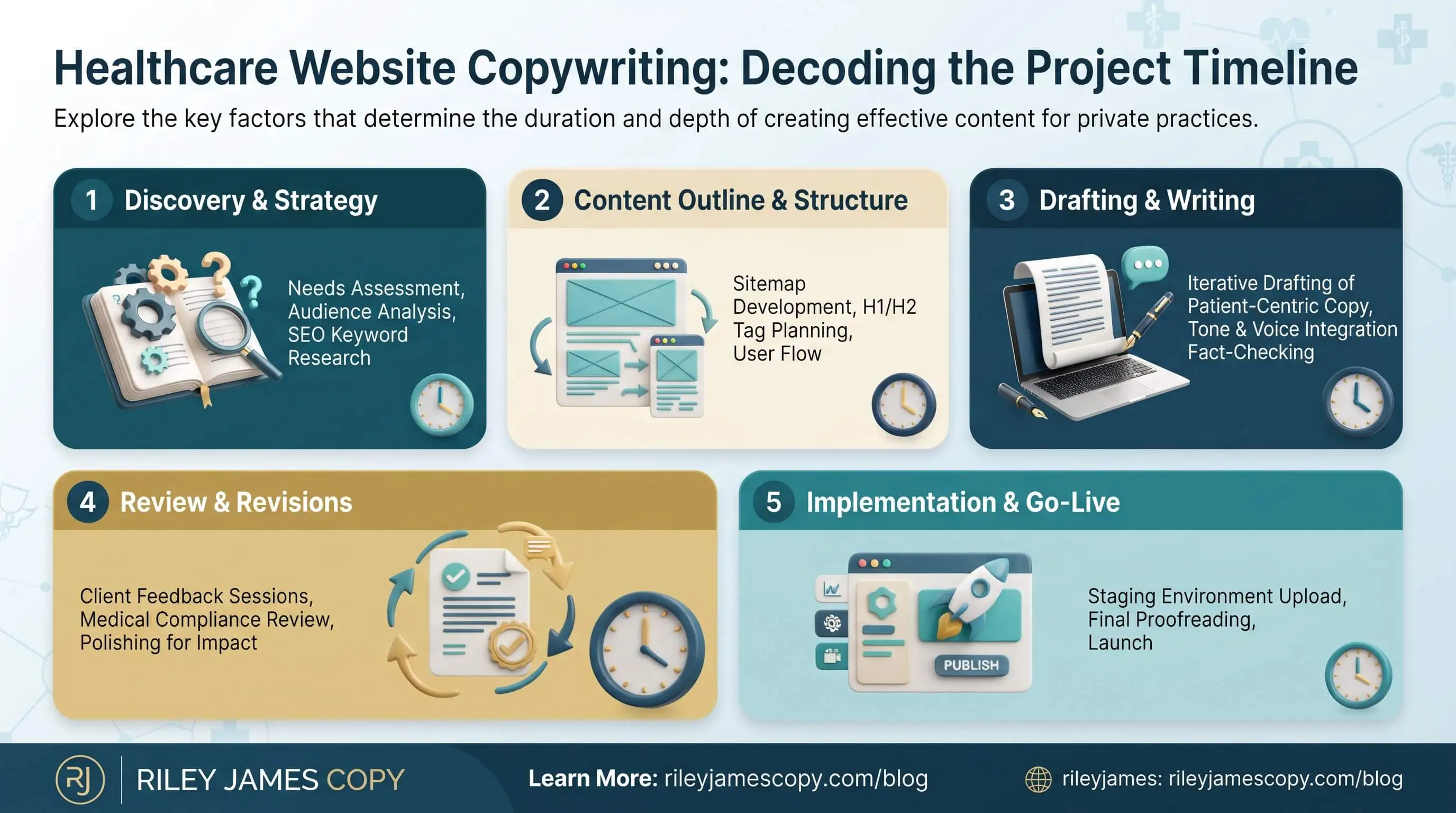
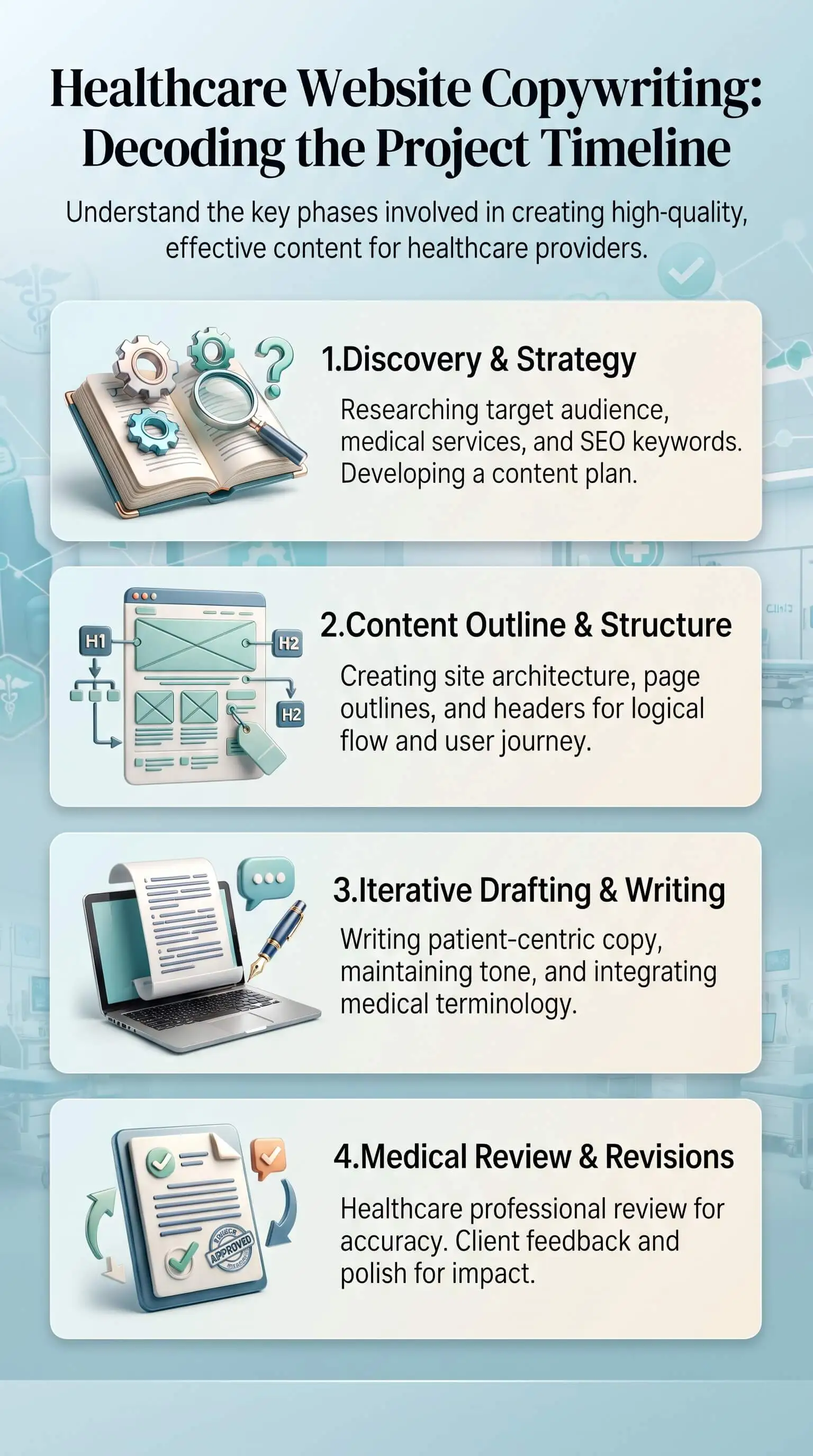
1. Discovery and kickoff (1 to 3 business days): A short intake form, a kickoff call, and me reading your patient reviews. Reviews show how patients talk about you, and that's the voice I write toward.
2. Research and page plan (2 to 4 business days): Keyword research, a look at the practices ranking above you, and a plan that gives every page one job.
3. First drafts (5 to 10 business days): The home page goes first because it sets the tone. Service pages follow.
4. Practice and clinical review (2 to 7 business days): You check every claim, fact, and patient-facing line. The range is wide on purpose.
5. Revisions (2 to 4 business days per round): Edits until it reads like you on a good day.
6. Final SEO polish and handoff (1 to 2 business days): Meta titles, headings, internal links, and files ready to drop into your site.
Add those up and you'd expect five or six weeks for medical healthcare copywriting services. Most projects still land at two to four, because the stages overlap. I start drafting while research wraps, and review can run page by page instead of waiting on the whole site.
The Stage Nobody Puts On The Calendar
Clinical review is the step practices forget to plan for. Picture a urology practice writing a page on prostate cancer treatment options. A physician has to confirm every line about outcomes and side effects before it goes live, and that physician is reading between patients. Two days turns into seven fast.
I'd never ask a practice to skip that step. Health claims answer to the FTC, and a page that overpromises does more damage than one that launches a week late. What I will ask for is an hour on the doctor's calendar, booked before I've written a word.
What Slows A Healthcare Copy Project Down?
The writing is rarely the holdup. One of these usually is:
Slow feedback. A draft that sits in an inbox for nine days adds nine days.
Too many decision-makers. Every extra partner who has to sign off adds a round of edits, sometimes two.
Missing pieces. Provider bios, headshots, insurance lists, and office hours nobody has written down yet.
Scope creep. "While you're at it, could you add a page for..." is how a four-week project becomes an eight-week one.
Specialty claims. Oncology, urology, behavioral health, and pelvic health pages need sources and careful wording, and getting that right takes as long as it takes.
How Long Do Single Pages And Blog Posts Take?
One service or landing page: about 5 to 7 business days, with one review round.
One blog post: about a week.
Multi-location or multi-specialty sites: six to ten weeks or more, and coordination eats most of that time.
Rush work is possible when the calendar allows, as long as someone on your end can turn feedback around in a day.
Who Sets The Pace?
Honestly, you do, more than any writer. The fastest projects I've run had one person at the practice who could say yes and mean it.
The other big factor is who you hire. At an agency, a draft can pass through three or four sets of hands before it reaches you, and every handoff costs a few days. Working one-on-one with a writer who focuses on private practice healthcare copywriting cuts those handoffs out. Your feedback goes straight to the person writing, and your voice doesn't get sanded down along the way.
Copy Done Is Not The Same As Ranking
Finished copy can be live in a few weeks. Showing up in Google usually takes months, depending on your competition and your site's history. Anyone who guarantees you a #1 spot is guessing, and Google's own hiring advice says so.
"After five-plus years of writing for independent clinics, I can tell you the writing almost never stalls a launch, but review often does. Drafts sit in a busy doctor's inbox between patients, and two weeks quietly turns into six. The practices that finish on time all do the same thing. They name one person who can say yes, and they book an hour for review before I've written a word. Hand me your patient reviews and that one decision-maker, and most private practice sites are done in two to four weeks."
Essential Resources
Seven worth reading before you put a copy project on the calendar, or while you wait on a draft. Skim the ones that fit where you are.
1. Know When A Patient Story Needs Permission
HHS spells out how HIPAA defines "marketing" and when you need a patient's written authorization. Any testimonial or case story on your site needs that sign-off first, and getting it adds days.
Source: HHS: HIPAA Marketing Guidance
2. See Why Health Claims Get Extra Review
The FTC expects health claims to be truthful, not misleading, and backed by solid evidence. That expectation is the whole reason your clinical review stage exists.
Source: FTC: Health Products Compliance Guidance
3. Build A Site Every Patient Can Use
Health Literacy Online is a research-based federal guide to health websites that people with limited time or reading skills can actually use. I'd keep it open during your review round.
Source: ODPHP: Health Literacy Online
4. Write So Patients Get It The First Time
The CDC's plain language page closes with a short checklist, and two items on it fix most drafts. Put the most important message first, and keep each sentence to one idea. Hand it to anyone on your team who edits drafts.
Source: CDC: Plain Language Materials and Resources
5. Check Your Copy Against What Google Rewards
Google's guide to helpful, people-first content lists the questions its systems are built around. Health pages face a higher bar than most, so read it before you approve the final copy.
Source: Google Search Central: Creating Helpful, Reliable, People-First Content
6. Ask About Timelines Before You Hire
Google suggests asking anyone you hire for search work what results to expect and in what timeframe. Ask your copywriter the same thing about delivery dates.
Source: Google Search Central: Do You Need SEO?
7. Make Every Page Readable For Everyone
The W3C's writing tips cover headings and link text that actually says where it goes. Those small habits help screen-reader users and search engines as much as they help patients.
Source: W3C: Writing for Web Accessibility
Supporting Statistics
A few numbers that explain why the extra days on your copy are worth spending. Each comes from a different research source.
1. Most Adults Look Up Health Information Online
From July to December 2022, 58.5% of U.S. adults used the internet to look for health or medical information. For a lot of those people, your website copy is the first conversation they ever have with your practice.
Source: CDC/NCHS Data Brief No. 482: Health Information Technology Use Among Adults
2. Nearly Half Of Adults Struggle With Health Information
About 90 million American adults, close to half, have trouble understanding and using health information, according to an Institute of Medicine report. Plain-language editing is what makes a health page usable for them, so it earns its spot on the calendar.
Source: National Academies: 90 Million Americans Are Burdened With Inadequate Health Literacy
3. Most Health Searches Start At A Search Engine
In a survey Pew ran in 2012, 77% of online health seekers said their last search started at a search engine like Google. That's why the final SEO stage belongs in the timeline instead of getting tacked on after launch.
Source: Pew Research Center: Health Online 2013
Final Thoughts And Opinion
Here's the honest version, from someone who'd rather give you a real date than a flattering one. Fast copy is easy, but fast, accurate copy that still sounds like you need a practice that answers its email.
A few patterns I keep seeing:
One decision-maker wins. Practices with a single point person finish weeks ahead of the ones that route every draft through a committee.
Prep beats rush fees. Bios, headshots, insurance lists, and hours gathered before kickoff save more time than paying to go faster.
Review deserves a calendar slot. A physician reading every claim keeps your patients safe and your practice out of trouble.
Plain beats are clever. I rewrote one occupational-health clinic's pages, and they went on to rank #1 for 33 of the searches their patients actually use. Plain answers to real patient questions did most of that work.
Clear words matter more in medicine than almost anywhere else, especially for patients who already feel unheard. The care that goes into clear, culturally aware patient communication in the exam room belongs on your website too.
My take, plainly: two to four weeks is a realistic target for most private practice sites. If someone promises a full site in three days, ask who's checking the facts.
Frequently Asked Questions
Q: How Long Does It Take To Write Copy For A Medical Practice Website?
A: Usually two to four weeks from kickoff to final draft, for a site with a home page, an about page, and five to eight service pages. Multi-location or multi-specialty sites can run six to ten weeks or more, mostly because of review and coordination.
Q: Can Healthcare Website Copy Be Rushed?
A: Yes, within limits. Rush work is on the table when the calendar allows. Clinical review can't be skipped, though, so a rush only works if someone at your practice can approve drafts within a day or two.
Q: Why Does Clinical Review Add Time?
A: Because health claims have to be right before they go live. A physician needs to confirm what each page says about conditions and treatments, and most physicians review between patients. Book that hour ahead of time and you'll save days.
Q: Should Copy Be Written Before Or After The Website Design?
A: Before, or at least alongside it. Designers can build around real words instead of placeholder text, which saves a round of layout fixes later. If nothing else, lock the page plan before design starts.
Q: What Can My Practice Prepare To Speed Things Up?
A: Name one decision-maker first. Then gather provider bios, headshots, insurance lists, office hours, and a link to your reviews. Practices that show up with those ready often shave a week off private practice healthcare copywriting projects.
Q: Do Revisions Add To The Timeline?
A: Each round adds two to four business days. I keep every client-requested edit free until you're happy, so the real limit is your calendar.
Q: How Soon Will New Website Copy Show Up In Google?
A: Usually not right away. Search visibility builds over months and depends on your competition and your site's history. Be wary of anyone who guarantees a top ranking, because Google's own advice says no one can.
Let's Get Your Practice Website On The Calendar
If you've already picked a launch date, let's check whether it holds up. Book a free 15-minute call with Riley James Copy, and we'll map out a timeline that fits your practice, with your actual review schedule built in, plus practical medical copywriting tips to keep yur project on track. No pitch attached.


